Newton’s Cradle is a familiar sight in classrooms, offices, and science museums—but behind its rhythmic motion is a story rooted in centuries of scientific discovery.
Named after Sir Isaac Newton, the Newton’s Cradle demonstrates three foundational principles of classical physics: conservation of energy, conservation of momentum, and the role of friction in mechanical systems. Through a simple series of swinging spheres, these abstract laws become visible, repeatable, and intuitive.
Who Invented Newton’s Cradle?
Although it bears his name, Isaac Newton did not invent the device we now call a Newton’s Cradle.
The modern apparatus was created in 1967 by English actor Simon Prebble, who developed it as a visual and tactile demonstration of ‘Newtonian physics.’ Prebble named the device in honor of Newton’s work on motion and momentum, recognizing how elegantly the cradle reflected those ideas.
By 1968, the first portable Newton’s Cradles were introduced to the market. They quickly gained popularity worldwide as both an educational tool and a desktop curiosity, bridging the gap between science instruction and everyday fascination.
How Newton’s Cradle Works
At its core, Newton’s Cradle is a demonstration of energy transfer through elastic collisions.
When one sphere is pulled back and released, it strikes the next sphere in the series and comes to an almost complete stop. The energy and momentum from that impact travel through the stationary spheres as a compression wave. Nearly instantaneously, the sphere on the opposite end swings outward, rising to almost the same height as the original release.
This behavior shows that:
Materials such as steel are particularly effective in Newton’s Cradles because their elasticity allows kinetic energy to be temporarily stored as potential energy during impact, rather than being lost as heat or deformation. Giant Newton’s Cradle applies this principle at a larger scale, using precisely engineered steel spheres and rigid structural components to make energy transfer easier to see, hear, and understand in real time.
Why Newton’s Cradle Endures
More than half a century after its introduction, Newton’s Cradle remains one of the most recognizable physics demonstrations in the world. Its lasting appeal comes from its simplicity and clarity—complex scientific laws revealed through motion anyone can understand.
Key moments in the evolution of Newton’s Cradle include:
Today, Newton’s Cradle continues to serve as both a scientific tool and a metaphor, illustrating how energy, actions, and consequences are interconnected.
A Timeless Demonstration of Motion
Newton’s Cradle endures because it does more than explain physics—it invites observation, curiosity, and reflection. With every swing, it quietly reinforces the idea that even the simplest systems can reveal profound truths about how the world works.
$229.95
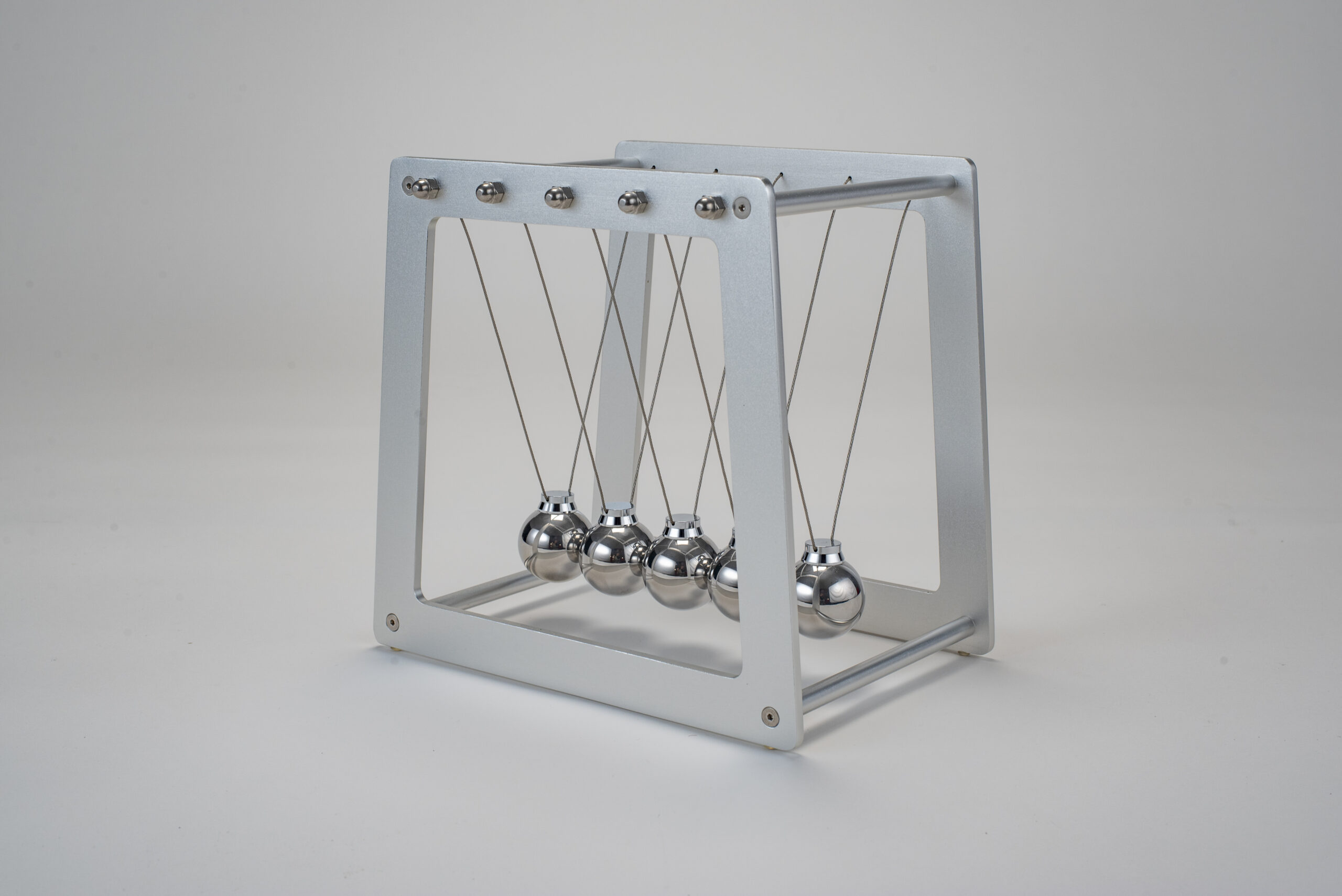
- 9.5"w x 9"h x 6.5"d
- Laser Cut Aircraft Aluminum Frame
- 1.5” Nickel Plated Chrome Steel Spheres
- Galvanized Aircraft Cable
- Total Weight 4.1 lbs
- Shipped Fully Assembled
- Custom Designed Packaging for Safe Transportation
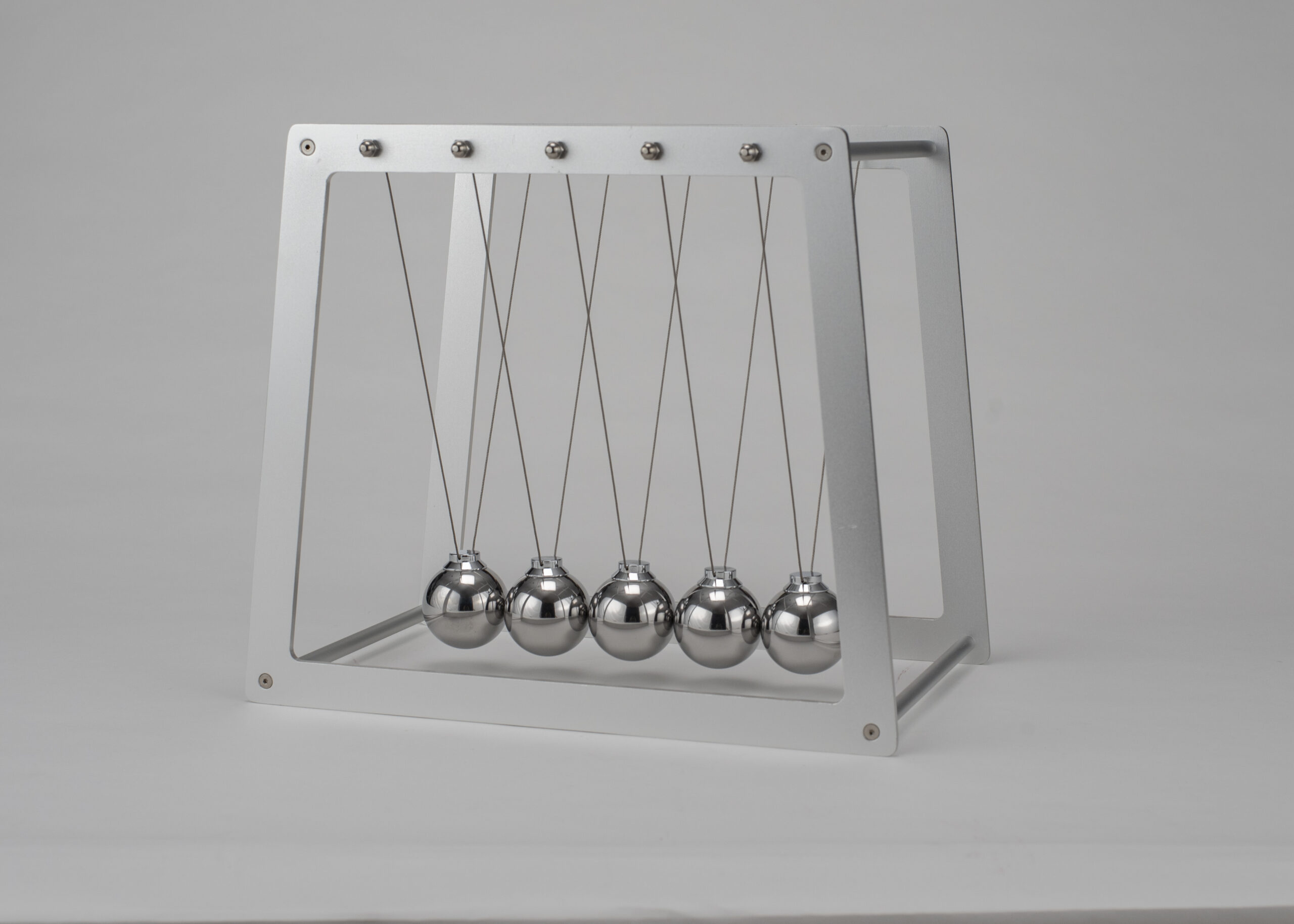
$449.95
- 14.5“w x 12.5“h x 9"d
- Laser Cut Aircraft Aluminum Frame
- 2” Nickel Plated Chrome Steel Spheres
- Galvanized Aircraft Cable
- Total Weight 10.96 lbs
- Shipped Fully Assembled
- Custom Designed Packaging for Safe Transportation
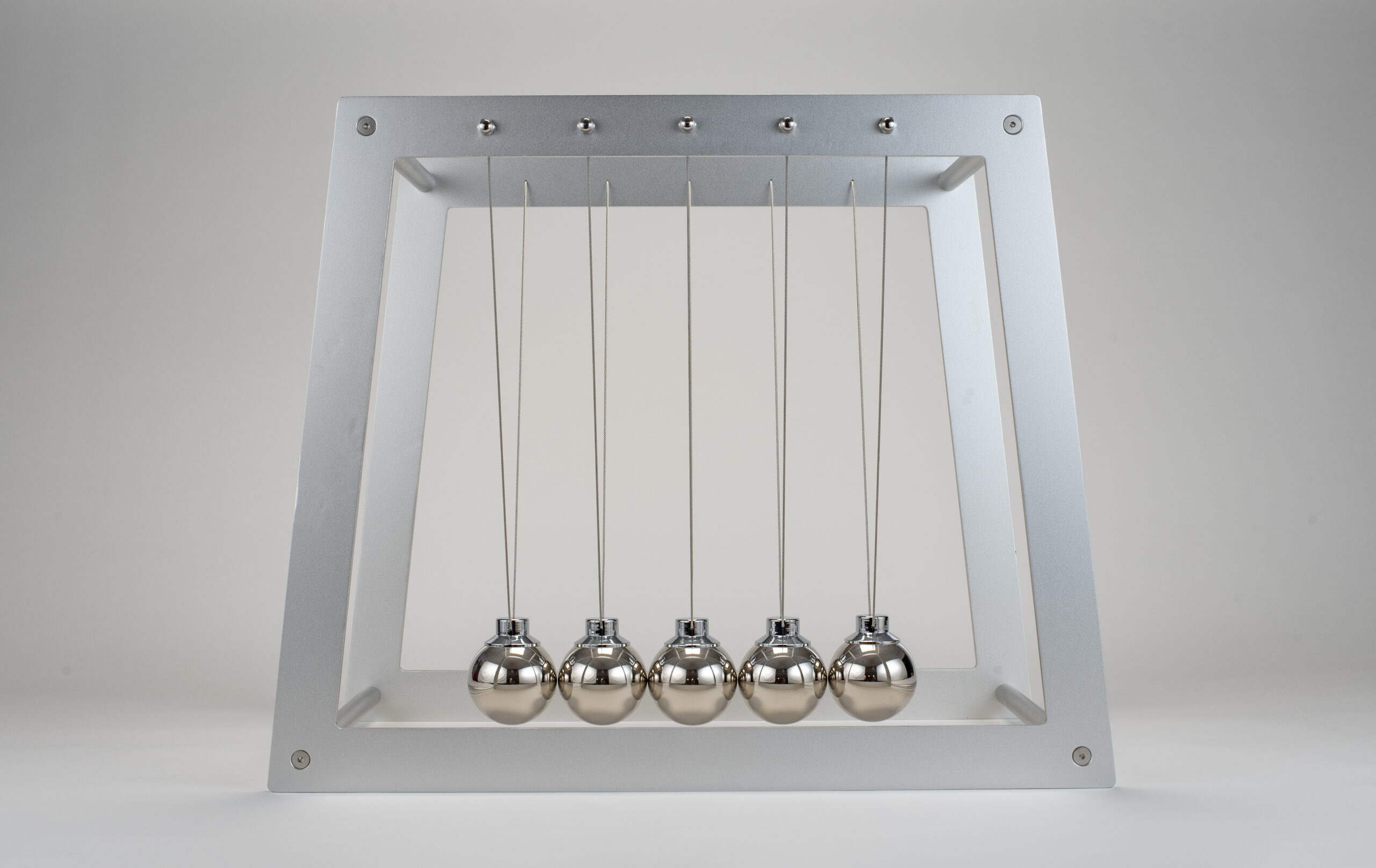
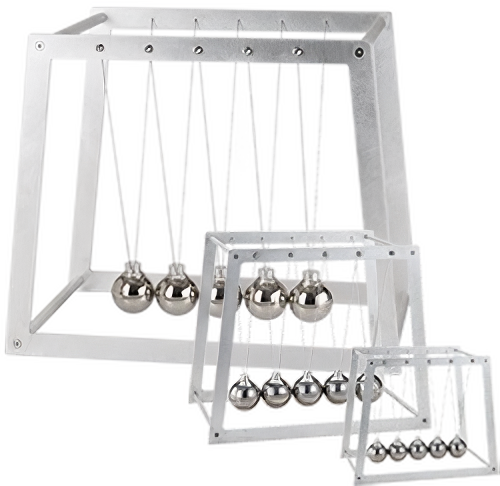
$2,395.95
- 34"w x 28"h x 20"d
- Laser Cut Aircraft Aluminum Frame
- 4" Nickel Plated Chrome Steel Spheres
- Galvanized Aircraft Cable
- Total Weight 59 lbs
- Shipped Fully Assembled
- Custom Designed Crate for Safe Transportation